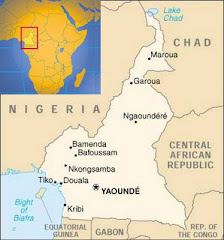
Because we live somewhat near the west of the country, there are more than a handful of people that come from English speaking areas. However, English here is either pidgin, which might as well be chineese with a few English words thrown in at random times in conversation, or it is the English of a non native English speaker-African English. Yes, there are people here in Cameroon who speak perfect (according to American standards) English, but many times their english is difficult for les blancs to understand. Most of us have started to adopt a Cameroonian English that we use when people ask us “Are you speaking English?”. When speaking to a Anglophone, we annunciate all of our words and speak very clearly (not slowly and loudly like we tend to do to non-english speakers in the US). Also a good tactic to use is to not conjugate all of your verbs. “I buy this” “I go to market now”. (Some Anglophones understand almost none of what I am saying so I revert to French, which doesn’t really help the situation. Our fish lady in town-Mommy Fish- is Anglophone, but most of the time I can’t understand her English so we speak French with each other.)
I’m getting pretty good at Cameroonian English, and combined with the fact that I spend a lot of time now with an Austrian girl who speaks Austrian English, I’ve developed quite an interesting form of speech. I do a wonderful Austro-Afro-English that involves improper conjugations and sentences that end in high pitch, eyebrow raising affirmatives. And after speaking like this for 6 hours a day at the hospital, I come home and can’t speak good old yankee English. I’m even thinking in a broken combination of French, English, and Fulfulde. Needless to say, brian has nearly thrown a book at me a few times when I come in and say “what you do today?” or “I say this to you, this is big problem”…
So as I just mentioned, I’m spending some time at the hospital now. I decided that not having an actual job and a weekly schedule that involved three meetings and some “talking to community members”, I needed more of a purpose here. The volunteer before us worked almost exclusively at the hospital, and told us that we shouldn’t work there because they don’t really have a job for us as volunteers. So I stayed away for the first three months. After coming back from our In Service Training, I was motivated to start doing some health work and to keep busy.
I started working at the hospital three days a week. It’s a busy hospital because the doctor is a very hard working Austrian woman and people come from all over the area to see her. She has been here for something like 20 years and usually has two or three young Austrians who come for 9 months at a time to fulfill their service requirements.
Because I have no health experience, I have started in the nutrition ward. Or better, the malnutrition ward. There is a young Austrian there now who will be leaving in a few weeks, so she has been showing me around and learning me the trade. We start the day by weighing all the newborn babies and talking to the mothers about breast feeding. The obvious goal is to have the babies gain weight each day and have the mothers eat well so they can breast feed well. Then we go to the children’s ward where we visit the sick children. There are kids there with tuberculosis, parasites, malaria, severe malnutrition and other equally debilitating illnesses. Again, we weigh them and talk to their mothers (its always the women who bring them in) about what they are eating.
When a child is particularly bad, we make them buille, the traditional porridge like food that everyone here eats. Usually it consists of flower, water and sugar, but we show the mothers how to make it more nutritious by adding soy and peanut butter. The hope is that they’ll starting giving this to all of their children when they go back home.
The problem so far is that because 90% of the women who are having babies or that bring in their sick children are from very rural areas and have not been formally educated, meaning they speak no French. I speak a small small amount of Fulfulde, but its imperative that I learn it in order to communicate with these women. Another problem is that food costs money, and these women have no money. To make them the buille, we ask that they go buy an egg and powder milk and soy. We can usually provide the oil and peanut butter and flour for them, but we can’t just give them everything for free (can we?). the ingredients that we ask them to get cost the equivalent of $1.50 (the soy is $1 but can last them for a whole week of buille) and they don’t have the money for it. Its frustrating because many times the father has money, or more often cattle, but does not give the woman the money, and since he’s not at the hospital with the family, there’s no way to explain to him that he needs to buy them this food.
A third problem is that many times when a mother dies, her extended family takes in the children, but with a family of their own and already thin resources, those children often get sick. One girl that is there now-in fact, she came the day I started and was the first child I saw- is one year old and weighs 6 pounds. Her mother passed away and her grandmother brought her to us. She has no money and I assume a whole family at home. She was gaining a little bit of weight the first week because we were giving her buille, but when Monday cam around, she had lost all the weight again. The grandmother said that because she had no money, they had nothing to eat on the weekend. (Being at the hospital here is not at all like home- I’ll take photos some day- everyone relies on family members to come bring them food and cook for them in the communal kitchen area. You have to bring everything from pots and pans to sheets and firewood. So, needless to say, its not easy to stay at the hospital for long periods of time). The little girl still hasn’t put on any weight, and now we know she also has TB.
On the other hand, there are success stories: a six year old girl came in weighing 20 pounds looking miserable and very weak, also having malaria. Within a week she was up walking around and smiling. So its not all bad, and I’m getting more used to holding 2 pound babies and seeing very sick people.
I’m hoping to do more work at the hospital in the future, maybe work in different areas, but first I have to learn Fulfulde. I’d like to be able to talk with the women about family planning, HIV, and other things, but for now I just smile and stumble through basic conversation which involves a few Fulfulde words, some French and lots of gesturing, followed by laughing women and shoulder shrugging.


16 years ago


1 comment:
Jessie-how heart-breaking it is to hear of the sick babies-Im sure just holding them is comforting ,but wish we could help with food.I'm proud of you.
Love-MOM
Post a Comment